
What Happens When We Are — and Aren't — Held: Attachment, the Nervous System, and the Lifelong Arc of Healing
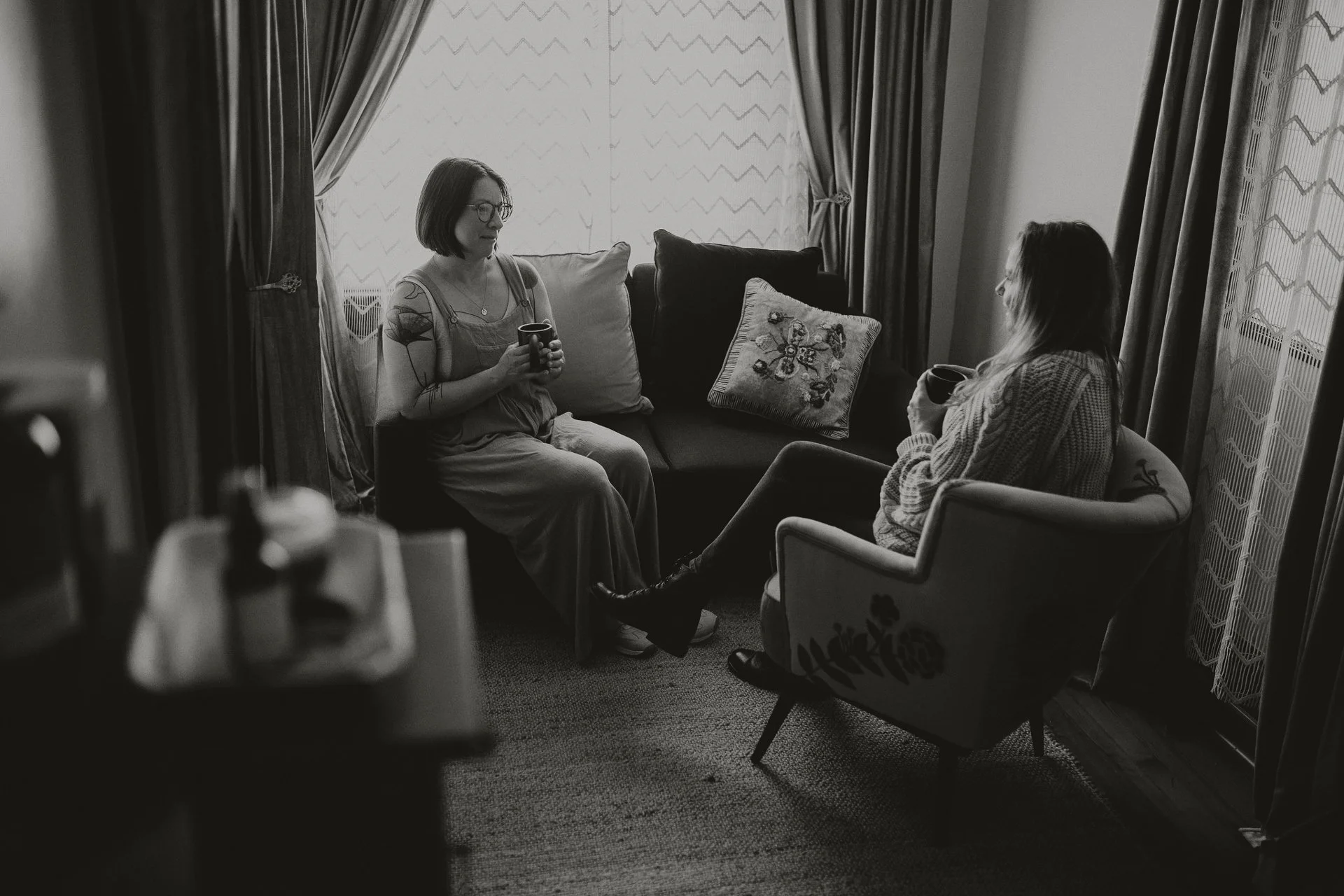
Jewell Whitmer, CNM, PMHNP, practices integrative mental health and midwifery at Flourish in Hillsborough, NC. She offers ketamine-assisted psychotherapy, integrative psychiatry, and perinatal care.
There is a kind of knowing that lives in the body before it ever reaches language.
I have witnessed it in birth rooms and therapy rooms alike — in the way a newborn settles onto a mother's chest, in the way an adult finally exhales after years of holding themselves together, in the subtle shift that happens when a nervous system realizes it is finally safe enough to soften.
As a midwife, particularly in out-of-hospital and home birth spaces, I have watched babies enter the world in quiet bedrooms lit by candles and rain-softened windows. I have seen labor unfold differently when a person feels safe, private, and deeply supported — the way oxytocin rises in protected environments, the way bodies open when they are not under surveillance, the way both mother and baby regulate through closeness, touch, breath, and presence.
And later, as a psychiatric mental health nurse practitioner working in ketamine-assisted psychotherapy, I began witnessing another kind of birth entirely: the moment a person begins returning to themselves.
More and more, I understand these as the same work.
What happens to a human being when they are truly held?
And what happens when they are not?
Two Books. One Arc.
Two books have lived beside each other in my mind lately: Attachment Parenting by William Sears, MD, and How to Reparent Yourself by Nicole LePera, PhD — known widely as The Holistic Psychologist.
At first glance, they belong to different worlds. Sears writes for new parents about infants and newborns; LePera writes for adults healing childhood wounds. But I experience them as two sides of the same coin — or more accurately, the beginning and the end of the same story.
Sears maps how safety, responsiveness, touch, and attuned caregiving shape the developing nervous system from the very first days of life. His foundational practices — babywearing, breastfeeding,
co-sleeping, responding to cries rather than managing them — are not trends. They are ancient biology. The nervous system of a newborn is not yet capable of self-regulation. It borrows regulation from the caregiver. Skin-to-skin contact, the breast filling in response to hunger, a voice that comes when there is crying — these are the earliest lessons the body learns about whether the world is safe enough to inhabit.
LePera picks up where Sears' world leaves off. Her work is for the adults who did not receive enough of what Sears describes — or whose early experiences were fragmented, unpredictable, or marked by subtle but chronic mis-attunement. Her reparenting framework asks a quietly powerful question: What if you became the parent your inner child still needs? Not as metaphor — as practice. The same qualities a caregiver offers a baby (attunement, consistency, emotional safety, compassionate presence) can be cultivated internally, toward the self.
Birth as Relational Imprint
Birth psychology expands our understanding even further. Dr. Michel Odent's work showed that physiologic, undisturbed birth supports not only bonding, but the neurobiological foundations of emotional regulation itself. Oxytocin — involved in labor, love, and stress buffering — flows most freely in environments where a laboring person feels protected rather than managed.
A body that feels watched contracts. A body that feels safe opens.
Stanislav Grof's perinatal psychology proposed that birth experiences may leave preverbal imprints on the psyche — around constriction, panic, trust, and the feeling of being supported or abandoned. Whether one holds these frameworks literally or metaphorically, the truth holds: babies are not passive participants in birth. And the nervous system remembers experience long before it can form narrative.
The Resilience of the Nervous System
One of the most hopeful truths I carry is that the nervous system is profoundly resilient. Secure attachment is not built through a perfect, uninterrupted stream of attunement — it is built through rupture and return. A caregiver misattunes, notices, and comes back. The child learns something essential: disconnection is survivable. Love can return.
So many adults I work with carry nervous systems organized around the opposite expectation. Beneath perfectionism, hyper-independence, chronic anxiety, people-pleasing, or emotional numbness, I often find the same thing: a younger self still waiting to be met.
This is why healing cannot happen through insight alone. Many wounds live beneath cognition — in the body, in vigilance, in shutdown, in the inability to fully rest inside connection.
The body remembers what the mind had to forget.
When Defenses Soften: Ketamine-Assisted Psychotherapy and the Inner Child
In ketamine-assisted psychotherapy, I witness what happens when long-held defenses soften. Ketamine temporarily quiets the default mode network — the part of the brain associated with rumination, self-criticism, and the rehearsed story of who we are. In that window of neuroplasticity and felt safety, what often surfaces is unexpectedly tender: grief, unmet needs, longing, or the younger parts of themselves that were abandoned in order to survive.
Underneath nearly all of it is the same question:
Am I safe enough to be fully here?
Ketamine-assisted psychotherapy does not heal attachment wounds on its own. But held carefully, within a trauma-informed and relational container, it can create conditions where the nervous system experiences something new — safety, compassion, and connection felt at a somatic level. Emerging research on MDMA and psilocybin points toward similar mechanisms: a temporary softening of the defended self, allowing the wounded self to be witnessed with something other than shame.
This is reparenting in its most embodied form. The inner child, surfacing — not to be managed, but to be met.
The Whole Arc
Whether I am sitting beside a laboring mother in her home, supporting someone through postpartum darkness, or accompanying a patient through ketamine-assisted psychotherapy, I find myself listening for the same moment:
The moment the nervous system realizes it no longer has to survive alone.
Attachment Parenting and reparenting are not separate disciplines. They are opposite ends of the same nervous system continuum. One asks how we help a child remain connected to themselves. The other asks how adults rediscover that connection after years of necessary adaptation.
If you are a new parent — breathe. The goal is not perfection. It is presence, repair, and return. Your baby's nervous system is not fragile; it is responsive. Every time you come back after a hard moment, you are building something that lasts.
If you are an adult and something in this aches with recognition — that ache is not weakness. It is the part of you that is wise enough to know what was missed, and still brave enough to reach for it.